




After five years of leadup, SB 343’s “Truth in Recycling” labeling restrictions, which will have far-reaching ramifications in the US consumer product market, finally becomes effective on October 4, 2026. SB 343 restricts environmental marketing claims that the state deems to be false or misleading by prohibiting the “chasing arrows symbol” and other recyclability indicators on products and packaging unless producers can demonstrate specific criteria are met.
While there are alternative ways to meet the recyclability criteria, products are generally considered recyclable if the producer can demonstrate they satisfy all the following requirements:
Accepted for collection by jurisdiction recycling programs collectively serving at least 60% of the California population
Sorted into defined streams by large volume transfer/ processing facilities that:
Collectively serve at least 60% of statewide recycling program
Send them to a reclaimer and reclaim them consistent with the Basel Convention
Satisfy specific composition and design limitations:
For plastic packaging, products or non-plastic products, the design does not include any components, inks, adhesives or labels that prevent recyclability
The product or packaging does not contain an intentionally added chemical identified in regulations from the US Food and Drug Administration (FDA) and the Office of Environmental Health Hazard Assessment (OEHHA) pertaining in the manufacture of food service packaging
The product or packaging is not made from plastic or fiber that contains intentionally added Per- and polyfluoroalkyl substances (PFAS), or PFAS at or above 100 parts per million
SB 343 places responsibility for recyclability labeling on the producer of the product and packaging, who must also substantiate that recyclability criteria are met. Cal. Bus & Prof. Code § 17580(a). This means companies must maintain documentation showing each of their covered products meet the recyclability criteria.
These requirements directly impact the commonly used “chasing arrow symbol”:
It also reaches variants of that symbol that are likely to be interpreted by a consumer as an implication of recyclability, including, but not limited to, one or more arrows arranged in a circular pattern or around a globe.” Cal. Bus & Prof. Code § 17580(f). This potentially includes other common industry recycling symbols, including the Terracycle Loop, the Green Dot, Corrugated Recycles, NAPM Recycled and others.
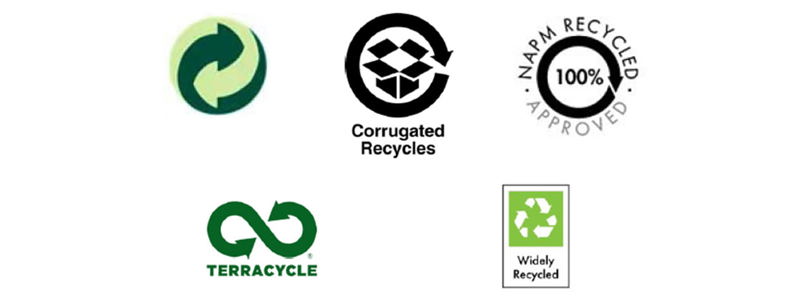
Therefore, it will be critical for all companies, but especially any foreign companies doing business in the US who may have UK-based or EU-based recycling symbols on packaging, to ensure compliance with SB 343 if its products make their way to the California market. In addition, any recyclability statements (as opposed to symbols) are also prohibited unless recyclability criteria are met. Careful review of all product labeling is necessary to ensure compliance.
Resin Identification Codes (RICs) also present challenges under SB 343. While California now provides that RICs may only use a solid equilateral triangle, 29 other states have RIC requirements that specifically mandate a chasing arrow symbol.
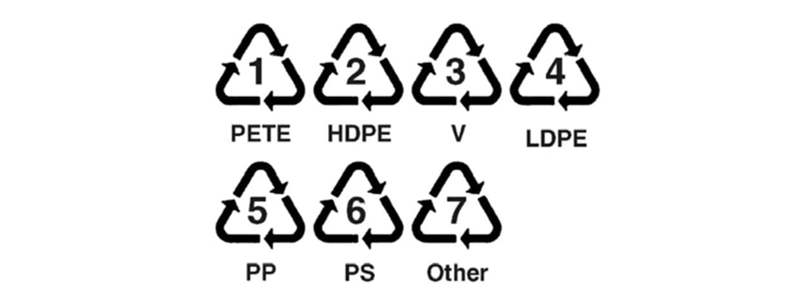
California’s SB 343 would likely deem these symbols “misleading” to consumers and in violation of Truth in Recycling. This leaves companies with no clear path for one set of uniform packaging that complies with all state laws, and CalRecycle has offered no guidance to help address this discrepancy. We recommend consulting with regulatory counsel to develop a tailored approach for your company.
Compliance with SB 343 will be crucial for several reasons, but there is one aspect of SB 343 that sets it apart from other laws. While SB 343 does not create a private right of action by itself, violations under SB 343 can be enforced by private citizens in consumer claims (e.g., California’s False Advertising Law, the California Consumers Legal Remedies Act and California’s Unfair Competition Laws) in addition to the enforcement by the attorney general. Moreover, a private citizen or member of the public is entitled to request (and a company must furnish) substantiation on SB 343 compliance if a consumer product has a recyclability claim, or chasing arrow symbol. Cal. Bus & Prof. Code § 17580(b). This threatens to create a cottage industry with increased risk of enforcement from citizen watchdog groups and litigious plaintiff attorneys. This has been the case in other areas of California law and notably Proposition 65’s similar labeling requirements.
Companies should have already or should now be assessing product compliance with SB 343, as there are less than six months left. Squire Patton Boggs is happy to assist with any questions on SB 343 or other packaging, labeling or recycling laws.


