


The purpose of this page is to track the implementation of the European Electronic Communications Code (EECC) across European member states and the UK. You can see implementation at a glance via the map below, or click on the links for each country to see a detailed summary of current status.
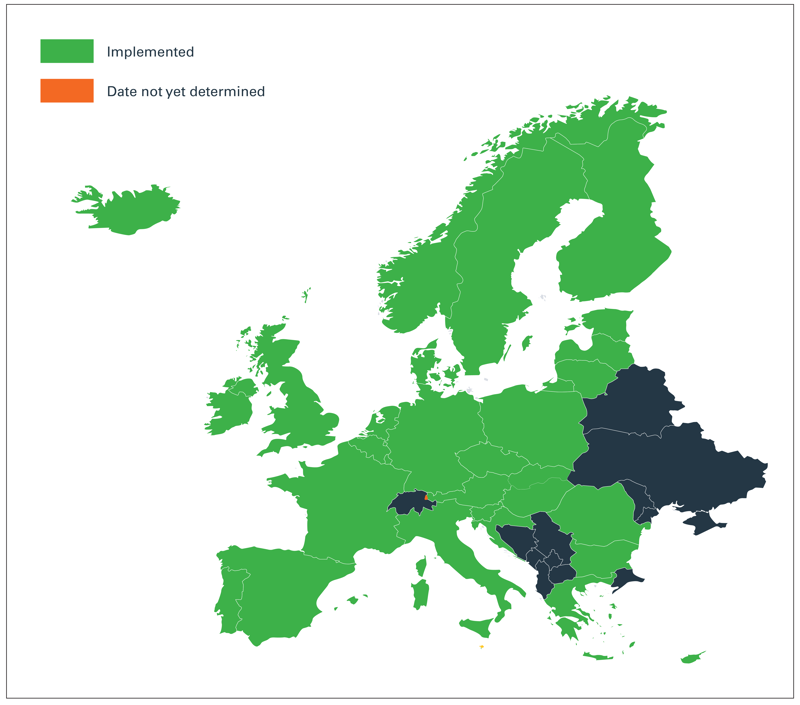
Please note that this material has been published for informational purposes only and does not constitute legal advice.
Please note that the UK has adopted a phased approach, with only a few consumer pieces to be implemented next year.
Choose a country from the list below to view its current implementation status.
Austria, Belgium, Bulgaria, Croatia, Cyprus, Czech Republic,
Denmark, Estonia, Finland, France, Germany, Greece,
Hungary, Iceland, Ireland, Italy, Latvia, Liechtenstein, Lithuania, Luxembourg,
Malta, Netherlands, Norway, Poland, Portugal, Romania,
Slovakia, Slovenia, Spain, Sweden, UK
Current status: Implemented as of November 1, 2021.
Legislation
New Austrian Telecommunications Act
This legislation entails network security aspects, including supply chain requirements for high-risk suppliers of telecommunications hardware, and consumer protection provisions, as well as specific data protection requirements for the telecommunications sector. The law also provides for the inclusion of number-independent interpersonal communication services and obligations for contracts.
The Number Portability Ordinance 2022 regulation on number porting between mobile voice communications entered into force on May 11, 2022.
The new regulation will adapt the existing provisions to the legal basis provided in the Austrian Telecommunications Act 2021. Of particular interest are the exemption from charges for number portability for end users, the discontinuation of the existing end user contract ex lege unless otherwise agreed, and the extension of the option for subsequent number portability to one month after the end of the contract.
Current status: Implemented on January 10, 2022, with certain articles subject to separate implementation timelines as specified in the law detailed below.
Legislation
After a one-year delay, Belgium has officially enacted legislation to implement Directive 2018/1972 of 11 December 2018, which established the European Electronic Communications Code (EECC). Although the original deadline for transposition was December 21, 2020, the Belgian law was ultimately adopted on December 21, 2021, and published in the Belgian Official Gazette on December 31, 2021 (Law Transposing the European Electronic Communications Code and amending various provisions relating to Electronic Communications).
The legislation introduces amendments to several existing Belgian laws but primarily the Law of 13 June 2005 on Electronic Communications.
The new act implements the EECC and some other provisions:
Enhancing easy switching between telecom providers
Forcing telecom providers to propose the most affordable prices to existing customers annually
Enabling easier screening for text messages so telecom operators are able to block spam messages
Most of the provisions entered into force shortly after the publication of the act on January 10, 2022.The provisions whose entry into force differ are the following:
Article 143 – Implementation of article 102 of the EECC, regarding the requirements of information in contracts, and article 105, are immediately applicable to existing contracts, unless for the obligations to which an explicit derogation of the consumer is possible; those enter into force in two years for contracts of an undefined period.
The same is provided for article 167, transposing article 107 of the EECC (bundled offers).
Article 145, implementing annex VI, section 1 of the EECC, regarding the detailed invoice, entered immediately into force to existing contracts.
Article 150, implementing article 105, §3 of the EECC (contract duration and termination), regarding the possibility for final users to terminate the contract at any time with a maximum notice period of one month, entered into force immediately to existing contracts.
Article 121, regarding certain requirements on the compensation of the social component of the universal service, will enter into force at a date yet to be determined by a Royal Decree.
Article 134 – On the possibility to adopt a Royal Decree providing for certain obligations to operators for the general interest. The Royal Decree may also give the Belgian Institute for Post and Telecommunications the power to impose prices to operators, for public interest. This article enters into force on the day the Royal Decree enters into force.
Current status: Implemented as of March 9, 2021.
Legislation
The EECC was transposed through amendments to the Electronic Communications Act in force as of March 9, 2021. The implementing legislation introduced provisions related to:
The inclusion of number-independent interpersonal communication services within the regulatory framework
Emergency call services and caller location information
Consumer protection, including transparency of contract terms, maximum duration and easier termination
Market competition, network access and regulation of very high-capacity networks
Secondary legislation has also been updated by the regulator – the Communications Regulation Commission (CRC) – to further detail key aspects of the new framework.
Current status: Implemented as of July 12, 2022.
Legislation
Electronic Communications Act (OG 76/22) – Note: This is the Electronic Communications Act that has subsequently been amended by the Cybersecurity Act (OG 14/24)
The new act will enable the accelerated development of electronic communications networks that will ensure the necessary connectivity and availability of very high-capacity networks, including fixed, mobile and wireless networks, and their use by all citizens and entrepreneurs. Further development of competition is also expected, in both the infrastructure and services sectors, through securing conditions for new investments in electronic communications networks and services.
Current status: Implemented as of March 4, 2022.
Legislation
The Law on Regulation of Electronic Communications of 2022 is the main piece of legislation transposing the directive, published in the Official Gazette of the Republic of Cyprus on March 4, 2022.
An additional two pieces of legislation have been passed, amending the Regulation of Electronic Communications and Postal Services Law and the Radiocommunications Law, which will essentially now be covered by the Law on the Regulation of Electronic Communications of 2022.
Current status: Fully adopted.
Legislation
On September 15, 2021, the Czech parliament published an amendment to the telecommunications law to improve competition in the market and the use of radio spectrum, reflecting technological innovations and development of broadband networks, and the protection of electronic communication services users: Amendments to Act No. 127/2005
The amendment implemented the EECC and, alongside making the aforementioned changes, it also affected the definition of terms, including electronic communication services, emergency calls and data retention.
Other relevant legislation:
Decree amending Decree No. 267/2017 Coll., and Decree No. 117/2007 Coll.
Decree No. 58/2022 Coll.. – On the conditions for number portability and changes of internet access service providers.
Current status: Implemented as of December 8, 2020.
Legislation
Executive Order on End-User Rights:
Slutbrugerbekendtgørelsen.
The issues now covered by Danish law include:
Number-independent interpersonal communications services
Stronger consumer protection ensuring transparency and support for consumer choice
Stimulating investment incentives for companies in digital infrastructure through increased competition and greater predictability of the regulation
Promoting the roll-out of digital infrastructure, including easier access to establish wireless access points with limited range for use of, among others, 5G networks
Current status: Entered into force February 1, 2022 unless detailed below.
Legislation
Electronic Communications Act, the Building Code and State Fees Act Amendment Act
The act Amending the Electronic Communications Act, the Building Code and the State Fees Act 437 SE transposes the EECC, into Estonian law.
The entry into force of the act varies, as follows:
Clauses 29, 31, 32, 35, 36, 43, 45 and 46 of this act entered into force on March 1, 2022
·§2 of this act entered into force on April 1, 2022
Clause 120 of §1 of this act enters into force on June 28, 2025
Clause 108 of §1 of this act enters into force on January 1, 2028
Current status: Implemented as of January 1, 2021.
Legislation
Reform of the Act on Electronic Communication Services – This has fully implemented the EECC into Finnish law.
An English translation is also available: Act on Electronic Communications Services (translations of statutes). Kindly note that this is not fully up to date, as changes have been made since the implementation of the EECC (1207/2020).
Current status: Implemented as of May 26, 2021.
Legislation
Transposition of the European Electronic Communications Code
The EECC is fully implemented in France. Changes include:
The definition of electronic communication services is broadened/made more specific to include services, such as over-the-top (OTT) services, machine-to-machine (M2M) services, etc.
Some of the obligations imposed on electronic communication operators are modified, e.g., prior notification to the French telco regulator, ARCEP, is no longer required
Deployment of high-capacity networks is facilitated
Rules related to national emergency service are modified, callers geo-tracking, “reverse” notification
Access and interconnection rules are strengthened
New ex ante regulatory obligations apply to operators having significant market power on a given market (under the joint control of ARCEP and the French competition authority)
Rules related to the assignment of radio spectrum numbering have been adjusted to optimize the use of spectrum bands and to facilitate the development of new service offers such as the internet of things (IoT)
Current status: Implemented as of December 1, 2021.
Legislation
Telekommunikationsgesetz (TKG)
The TKG transposes the EECC into national law. It became effective from January 12, 2021.
The act removes obstacles to the expansion of mobile and cable-based telecommunications networks, to create legal and investment security, to ensure the nationwide provision of telecommunications services and to provide incentives for the expansion of fiber-optic networks.
Some of the changes include:
The scope of application will include all enterprises or persons operating telecommunications networks or telecommunications installations or providing telecommunications services within the scope of the act, as well as other persons entitled and obliged under the act – this is true even if there are no registered offices in Germany
The definition of “telecommunications service” is extended to include:
Internet access services
Interpersonal telecommunications services
Services that consist wholly or mainly of the transmission of signals, such as transmission services used for machine-to-machine communications and for broadcasting
However, number-independent interpersonal telecommunications services are exempt from the notification requirement
Provider switching and number portability shall be carried out under the direction of the acquiring provider
A statutory entitlement to be provided with a high-speed internet access service is introduced for end users under the new rules
Current status: Implemented as of September 23, 2020.
Legislation
Law 4727/2020 transposes into Greek legislation (i) EU Directive 2016/2102 on the accessibility of websites and mobile applications of public sector bodies; (ii) EU Directive 2019/1024 on open data and the re-use of public sector information; and (iii) EU Directive 2018/1972 establishing the European Electronic Communications Code.
Additionally, it replaces, to an extent, law 4070/2012, and defines the competence of the Ministry of Digital Governance and the Hellenic Telecommunications and Post Commission (EETT), as well as the Hellenic Authority for Communication Security and Privacy. The G-Cloud (public sector), the RE-Cloud (research sector) and the H-Cloud (health sector) are updated and reinforced while the cloud-first policy principle is implemented.
Current status: Implemented as of December 21, 2020.
Legislation
Electronic Communications Act (Act LXXXV of 2020 amending Act C of 2003 on electronic communications as regards the obligation to transpose the directive establishing the European Electronic Communications Code).
Consolidated language of the Hungarian Electronic Communications Act: Hungarian Electronic Communications Act.
The EECC has been fully implemented into Hungarian law.
Current status: Implemented as of September 1, 2022.
Legislation
The Icelandic Telecommunications Act No. 70/2022 implements the European Electronic Communications Code (EECC) into Icelandic law.
All legislative steps have been taken and the EECC is now fully implemented.
Current status: Implemented as of November 30, 2023.
Legislation
All legislative steps have been taken and the EECC is now fully implemented.
Current status: Implemented as of April 11, 2025.
Legislation
Italian Electronic Communications Code establishing the EECC was announced as a legislative decree.
Current status: Implemented on July 14, 2022 (entered into force on July 29, 2022).
Legislation
The Electronic Communications Law implementing the EECC.
The rules determine:
Distribution of radio frequency spectrum bands for radio communication types and classification of radio communication systems
General conditions for the use of radio frequencies and radio frequency spectrum bands, including:
Radio interfaces
Permission to use a shared radio-frequency allocation
Current status: The EECC came into force on February 1, 2025.
Legislation
The EECC has been incorporated into the Agreement on the European Economic Area and its transposition into national law has been completed in the form of the Liechtenstein Act on Electronic Communication (Communications Act), which came into force on February 1, 2025.
Various ordinances accompanying the new Communications Act provide for a more detailed framework regarding the rights and obligations of providers and users of electronic communications networks and services, numbering resources, Liechtenstein web domain, and the rights and obligations of the regulatory authority on communications.
The most important changes include:
Increased consumer protection and the systematic adjustment of universal services
Changes to radio spectrum management, by way of an EU-wide harmonization of the allocation and use of spectrum. There is also a longer period of validity (20 years) for authorizations to use EU-wide harmonized spectrum.
Provisions relating to frequencies, numbering resources, communication parameters and the “.li” domains – all of which are now regulated individually
Current status: Consolidated version in force from January 1, 2025.
Legislation
The full up-to-date telecommunications law (which also includes EECC transposition provisions): Law on Electronic Communications of the Republic of Lithuania.
The law transposes the EECC into the Lithuanian national law. The communications regulatory authority, Rysiu Reguliavimo Tarnyba (RRT), summarizes the key changes as follows:
The broader definition of an “electronic communications service” is now broken down as follows:
Internet access services
Interpersonal communication services
Services consisting mainly of signal transmission
Changes to radio spectrum management, by way of an EU-wide harmonization of the allocation and use of spectrum. There is also a longer period of validity (20 years) for authorizations to use EU-wide harmonized spectrum.
In terms of access to ultra-high bandwidth networks, operators will be encouraged to co-invest in high-bandwidth public communications networks (both fixed and mobile), thus sharing business risk. An operator with significant market power (SMP) will be able to co-invest in the construction of new networks under clear and transparent conditions.
The RRT will be required to conduct market research every five years, instead of three as before, to ensure the consistency of the regulatory environment and reduce the administrative burden.
The scope of universal electronic communications services has been revised and the obligation to provide telephone services via payphones will be abolished, but the obligation to provide affordable universal e-communications services to certain groups of consumers will be introduced.
Favorable changes to ensure the protection of consumer interests. The adoption of legislation implementing this law will make it simpler and easier to change service provider for consumers using both interpersonal communications and internet access services.
Current status: Implemented as of December 26, 2021.
Legislation
Law of 17 December 2021 transposing Directive (EU) 2018/1972 of the European Parliament and of the Council of 11 December 2018, establishing the European Electronic Communications Code and amending the amended law of 30 May 2005 on:
(1) Organization of the Luxembourg Regulatory Institute
(2) Modification of the amended law of 22 June 1963 establishing the salary system for civil servants
Current status: Legislation has been passed to implement the EECC.
Legislation
Electronic Communications (Regulations) Act
Electronic Communications Networks and Services (General) Regulations)
Malta has now passed legislation to adopt the EECC through various new regulations and laws. Most of Malta’s existing telecommunications regime will be amended to transpose the EECC.
Current status: Implemented on March 12, 2022.
Legislation
Decision of 24 February 2022 amending various orders in council with regard to the implementation of Directive (EU) 2018/1972.
Essentially, all EECC implementation act provisions have entered into force, except for some limited e-privacy-related provisions. Amendments of certain subordinate legislation to implement the EECC are also now in force, including:
Expansion of telecom regulation to number-independent interpersonal communications services
Framework for access and interconnection on a wholesale level
Access remedies for providers with significant market power
Universal service obligations
Number portability rules
Information requirements for consumers, including small and medium-sized enterprises (SMEs)
Information requirements for all end-users
Extension of requirements to bundled offers
Equivalent access for end-users with disabilities
Access to the European emergency number
Current status: The new act entered into force on January 1, 2025.
Legislation
The Electronic Communications Act (Ecom Act) implemented the EECC and replaced the previous law of July 4, 2003.
The law will regulate and provide a framework for the electronic communications sector and the data center industry. It also governs mobile and broadband services, other traditional electronic communication services and electronic communication networks.
Specifically, the new act incorporates the following:
Number-independent person-to-person communication services are included, e.g., messaging services in internet-based applications or on social media – although these services are only subject to certain provisions, such as specific security requirements.
Data centers are regulated for the first time, with the regulation intended as an initial framework that can be expanded over time, as needed. The law introduces a registration requirement for data centers and imposes requirements for proper security and preparedness in data centers.
Electronic communication networks and services must maintain adequate security in times of peace, crisis and war.
Provisions relating to lawful access to information by the police and other authorities. In addition, cookies are regulated under the law and the rules on consent are tightened to ensure that consent is a voluntary, specific, informed and unambiguous expression of will given through a declaration or a clear affirmative action.
Sector-specific market regulation whereby predefined markets are analyzed, and providers with significant market power are identified. Furthermore, providers with significant market power may be required to grant competitors access to their electronic communication networks if access to infrastructure is insufficient to promote sustainable competition. The law grants the Norwegian Communications Authority the competence to set conditions for such access. Providers with significant market power can influence the obligations imposed by the Norwegian Communications Authority by committing to co-investments with other providers in new networks with very high capacity. However, those providers with significant market power that only operate in the wholesale market are granted regulatory relief.
Rules on establishing a national frequency plan, procedural rules for allocation, revocation and modification of frequency resources, the right to use frequencies allocated to others, and rules to safeguard national security interests.
Rules on the establishment and operation of small cell base stations, including an obligation for state, county and municipal authorities to accommodate reasonable requests for access to physical infrastructure to establish such small cell base stations. Limited resources such as numbers, names and addresses for electronic communication are also regulated under the law.
A framework for Norwegian country-code top-level domains and other domain names of national significance.
The regulation of consumer rights in the field of electronic communications, such as prohibitions against discriminatory requirements or terms, the right to contract summaries, cost control, price comparison services, and access to emails after the termination of a subscription agreement.
The extension of certain consumer protection rules to apply to micro-enterprises, small enterprises and nonprofit organizations that purchase services.
The imposition of a broadband delivery obligation – although such an obligation will only be relevant if other less intrusive measures, such as broadband support schemes, are insufficient.
The framework for an appeals board to handle most complaints regarding individual decisions made by the Norwegian Communications Authority in cases under the Electronic Communications Directive. The law also includes a regulatory authority to establish the detailed rules for the appeals system.
Furthermore, the regulation on the establishment of the Body of European Regulators for Electronic Communications (BEREC) was incorporated into the EEA Agreement on September 24, 2021. The Electronic Communications Act includes a regulatory authority to incorporate the regulation into Norwegian law. This will enable the Norwegian Communications Authority to participate in BEREC and places its work on an equal footing with other European regulatory authorities, albeit without voting rights.
Current status: Implemented on July 12, 2024.
Legislation
On July 12, 2024, the president of Poland signed two legislative acts implementing Directive (EU) 2018/1972 of the European Parliament and of the Council of 11 December 2018, which established the European Electronic Communications Code (EECC Directive).
The first of these acts is the Electronic Communications Law (Act), while the second is an accompanying statute introducing supplementary provisions necessary for the Act’s implementation.
Under the transitional provisions of the accompanying statute, the Act was initially scheduled to enter into force in November 2024. According to the European Commission, an EU directive is considered fully transposed only once the implementing legislation becomes legally effective. Although certain provisions of the Act were initially intended to become effective on different dates, as of today, the entire Act is in full force and effect. Accordingly, the transposition of the EECC Directive into Polish national law is now complete.
According to the Polish Ministry of Digital Affairs, the implementation of the EECC Directive through the Electronic Communications Law has resulted in several significant reforms aimed at improving consumer rights, market transparency and regulatory efficiency. The key changes include:
Enhanced transparency of telecom offers
Elimination of unclear or hidden extra fees
Introduction of advanced mobile location (AML)
Easier comparison of telecommunication services for consumers
Standardization of universal mobile device chargers
Standardization of contract rules
New procedures for filing and processing service complaints
Updated registry obligations for telecom operators
Long-term spectrum reservations (15 to 20 years, with renewal options)
Transparent rules for frequency allocation and renewal by UKE
Defined responsibilities in spectrum management
Introduction of regional telecom access decisions, replacing individual permits
Current status: Implemented on August 16, 2022.
Legislation
The new legislation maintains the framework of competences of the national regulatory authority (ANACOM), without prejudice to the involvement of various other public administration actors, such as the government, autonomous regions or local authorities.
Changes to the law are also documented on the public database of the Public Prosecutor.
Current status: Implemented as of July 10, 2022.
Legislation
The legislation amends and supplements certain normative acts in the field of electronic communications and establishes measures to facilitate the development of electronic communications networks, as well as the location of infrastructure elements to support the development of these networks.
It broadens the scope of application of the rules in the electronic communications sector by extending the definition of the electronic communications services (ECS) to cover number-independent interpersonal communications services, among others. This category may cover certain activities carried out by email providers, internet calls and instant messaging through different platform providers, as well as other OTT services providers.
This has several practical implications, including the fact that the electronic communications-related requirements will be imposed on the new categories of ECS providers that now fall within the scope of the legislation.
Current status: The Act on Electronic Communications has been valid since June 28, 2025.
Legislation
The Act on Electronic Communications implemented EU Directive 2018/1972: 452/2021 Z.z. – Zákon o elektronických komunikáciách
Nonetheless, the directive itself was primarily implemented into new legislation: Act No. 351/2022 Coll. on Accessibility of Products and Services for Persons with Disabilities and on the Amendment and Supplementation of Certain Laws.
The new law regulates the following topics:
Authorization to provide networks or services
Network operation
Frequency and number management
Access and interconnection
Competition
Provision of services
Security and integrity of public networks and services
Protection of privacy and personal data
Provision of subsidies in the electronic communications sector
Supervision by the office of public regulated services
Sanctions
Current status: Implemented on November 10, 2022.
Legislation
Directive 2018/1972 (European Electronic Communications Code) has been transposed through the Electronic Communications Act (ZEKom-2)
The act regulates the powers, organization and operation of the Agency for Communication Networks and Services of the Republic of Slovenia as the independent regulatory body and the powers of other bodies performing tasks under this act, as well as other issues related to electronic communications. The act covers:
General provisions
Terms for providing electronic communication networks and services
Building networks and associated infrastructure and promoting connectivity
Disposal and limitations of title
Radio frequency spectrum management
Digital broadcasting
Managing the elements of numbering
Security of networks and services and operation in threat conditions
Ensuring competition
Universal service and additional mandatory services
Rights of users
Processing of personal data and privacy protection of electronic communications
Agency
Conflict resolution
Control
Electronic communications council
Penal provisions
Kindly note that there have been some minor amendments to the act, specifically adjustments to certain articles due to the entry into force of the Information Security Act. The amendments were necessary to avoid inconsistencies between the two laws, to prevent unnecessary duplication of certain obligations, and to ensure compliance with EU laws (as Directive 2022/2555 also amends Directive 2018/1972).
Current status: Implemented as of June 28, 2022.
Legislation
Act 11/2022, of 28 June 2022, on General Telecommunications
The new act introduces new developments of interest to the telecommunications sector, including a new classification of electronic communications services, the creation of a single point for information and processing of permits for the deployment of networks, the strengthening of users’ rights, and the optimization of the processing of the general operators fee.
The act’s main objective is to promote investment in very high-capacity networks. Important changes are introduced in the public radioelectric domain, incorporating measures to facilitate the shared use of the radioelectric spectrum by operators and avoiding undue restrictions on the implementation of wireless access points for small areas. The act also incorporates advances in the protection of the rights of end-users of telecommunications services.
Current status: Implemented as of June 3, 2022.
Legislation
New Electronic Communications Act (2022:482) on electronic communication
Ordinance (2022:511) on electronic communications
The new act introduces new and detailed rules regarding the information that shall be provided to end-users before entering into an agreement. The Post and Telecom Authority is additionally provided the power to impose penalty fees for certain types of violations. The penalty fee shall be set at a minimum of SEK5,000 and a maximum of SEK10 million.
Many of the provisions in the new act correspond to those of the former Electronic Communications Act. However, the following amendments are of interest:
Number-independent interpersonal communications services, such as email and messaging services, are covered by the new act
An obligation for providers of publicly available electronic communications services to provide a contract summary before entering into an agreement with a consumer
Obligations regarding bundles
Further, a new Electronic Communications Ordinance and a number of new regulations from the Post and Telecom Authority entered into force on June 3, 2022.
Current status: Partially implemented excepting certain end-user rights requirements.
Legislation
Provisions within the legislation include:
Mobile providers banned from selling locked mobile devices
Extended rules on accessibility for disabled customers
New rules for bundles, including other services or equipment sold with a communication service
Better contract information and stronger termination rights
In addition to this statutory instrument, Ofcom’s General Conditions had to be taken into account, as the more granular requirements outlined in the EECC are enforced through these conditions.
Improved switching processes for landline, broadband and mobile provisions have been proposed for April 2023.
Our Solutions
The EECC Compliance Solution outsources your compliance with the EECC notification and registration requirements across the whole EEA for an annual fixed fee. We do it all and track it for you, saving you time and money.
Our Digital Communications Market Access Tool (DCMAT) allows you to identify the risk of whether the launch of a new service/app or its expansion in a new market might require a licence or general authorisation in 75 jurisdictions worldwide. This tool is available on a free trial basis.